Showing posts with label AP Stylebook. Show all posts

Thursday, March 27, 2014

Navigating through the AP Stylebook

Sarah Lichterman

The Associated Press Stylebook is the bible of rules for writing news. My sophomore year of college, I took an entire classes dedicated to learning the ins and outs of this book. Back then, I had no idea how useful this training would be. Even though I have memorized many of the rules in the book, I still refer to it pretty much every time I write a news release to double-check a rule. Sometimes, I kick myself for having to look up a rule I should know one more time. But, I have come to realize that it is better to be safe than sorry. 

I have decided that instead of continually reading the AP Stylebook (a task similar to memorizing a dictionary), my familiarity with knowing what word or phrase has a rule and knowing how to quickly find a rule is sufficient. 

Knowing that a word or phrase has a rule is helpful, even though I may not know what the rule is. I find that this is my area of expertise. Because of my college days of memorizing rules, I am at least aware of what needs to be looked up, even if I do not know what the rule is off the top of my head. Because of this, I am regularly referring to my copy of the AP Stylebook. Nevertheless, navigating through the book can have its difficulties.
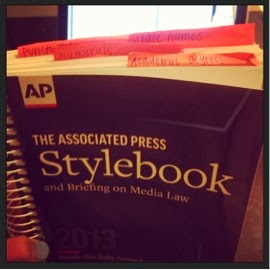
I am a book person. Even though the Stylebook is available online with a registered login, I prefer to use my hard copy. However, this can sometimes be difficult because the book is set up to not repeat rules often, even if it seems applicable. For example, if you are looking for the rule to see if a city can stand alone in a dateline, the first place you would naturally tend to look is under “C” for “cities.” However, you will only find the rule for “city” which is to “capitalize city if part of a proper name, an integral part of an official name, or a regularly used nickname: Kansas City, New York City, Windy City, City of Light, Fun City. Lowercase elsewhere…” This will not help answer your question. The correct answer can be found under “datelines.”

Here are a few examples of other rules that are frequently used and are not as easy to find as they should be.

  • Academic degrees. The rule for properly mentioning a degree to establish someone’s credentials or use in a biography. My first instinct is to always look under “D” for “degrees” instead of under “A.” The rule for “academic degree” gives a thorough explanation for all types of degrees and how you reference them. You can also look up specific degrees for a brief explanation of how to write them under the entry for “Bachelor of Arts, Bachelor or Science” and “Master of Arts, Master of Science, Master of Business Administration.” 
  • Dates. The rule for correctly writing a date. You would think that looking for “date” would give you the answer. However, this entry only gives you the rule to use Arabic figures, and does not mention how you should write the months of year. The complete rule for dates is located with the rule for “months” and referenced under “years.”
  • Numbers. The rule for how to reference numbers. However, there is no “numbers” entry in the book. There is a “numerals” entry that gives a brief explanation for how to use numbers for pretty much any situation including addresses, ages, vehicle names, dimensions, ratios, chapters, recipes, temperatures and more. Each of these topics has an in-depth explanation in their own entry.  

The Stylebook also has different sections with rules for specific topics. These sections are designed to make it easier to search for rules pertaining to these topics (as long as you know the section exists).

  • Punctuation. This section is dedicated to how to use punctuation marks. It lists all the rules for punctuation by symbol, rather than how the symbol is used. For instance, if you are looking for the rule for using a possessive noun or pronoun, you would look under “apostrophe” instead of under “possessive noun.”
  • Sports. This section explains rules for words and phrases pertaining to variety of sports such as scores, titles and names. It also contains definitions for commonly used sports jargon, as well as conferences, divisions and tournament information.
  • Food. This section shows common culinary conversions and writing guidelines for recipes. It also contains a complete list of food items and cooking techniques that explains the definition of the word and how to capitalize these items.
  • Fashion. This section contains the definition and writing rule for fashion and fabric terms, such as “A-line,” “epaulet,” “haute couture” and “pleat.” It also lists famous and commonly known fashion designers and gives a brief background on the designers.

These are just a few of the many tips and tricks to navigate through the AP Stylebook in order for you to efficiently and quickly finish your writing piece. I also suggest using Post-it notes to mark your frequently used rules. One day, I hope to know all the AP rules off hand, but I know that will come with time. For now, I will stick with my knowledge of what words need a rule and how to find them. If you know any other tips, please feel free to share in the comment section!


Wednesday, December 11, 2013

Apps for PR pros on the go

Lauren Hannaford

I’m sure we all have Facebook, Twitter, Instagram and all of our local media’s smartphone apps downloaded and saved to our home screens, but what apps are other PR pros using? I’ve been using a few different productivity and news apps for a while, but recently I’ve been scrolling through the app store for new ideas. Many of my favorites actually apply to more than just PR pros. Here are a few:

  • Pulse News- Pulse is the only Android-only app I use, and I use it on my Kindle. So far, it’s my favorite newsreader, and I roll sources like BBC News, FOX News, USATODAY.com, NBC News headlines, CNN.com, Washington Post, Associated Press top news, etc. into my feed so I can read through headlines quickly. 
  • Dropbox- I use Dropbox on my laptop for several projects. The app is great when I’m away from my computer and I need to reference a document quickly. 
  • Evernote- This is seriously the best app for note-taking, organizing web clips and photos, adding reminders to note and sharing notes. You can also sync from phone to tablet to desktop. 
  • GoToMeeting- If you are a PR pro on the go, this is a given. 
  • AP Stylebook- OK, so the app is $24.99, but it makes finding AP style answers a breeze. You can just as easily log into your account via your phone or tablet’s browser and save it to your bookmarks. 
  • Compete Site Analytics- Have you ever been talking with someone about what local news outlet site has more visitors? This app ranks sites and gives you  a look at basic analytics. 

I’m still waiting for Vocus PR to come out with an app. For now, the mobile version is pretty good.  What’s the best app you’ve downloaded that you use for your job? Let us know! 

Tuesday, April 30, 2013

The 10 most common grammar & AP Style mistakes, plus the importance of using AP style

Kim Morrison
Is it sad that when I saw this topic in our blog list I got just a little giddy? I’m very much a grammar nerd. I cringe while reading most Facebook posts, using every bit of willpower to ignore the need to correct the poster. I’m the person my friends and (previous) co-workers will ask to edit something, and I’m usually the first to start rattling off letters when someone asks how to spell something. Interestingly enough, I was an English major before switching to journalism, so there were many habits I had to change to become compliant to the AP Style gods. Here’s a list of some egregious grammar issues and AP Style errors.

That vs. which


This is one that still trips me up. That is used for essential clauses (the sentence would lose its meaning without the clause) and doesn’t use commas. Which is used with nonessential clauses (meaning the sentence doesn’t lose meaning without the clause) and uses commas. I came up with a little rhyme to help with this; use that when you have to have it, use which when you can ditch it.


Its vs. it’s (plus their vs. there vs. they’re and you’re vs. your)
This is a simple one that drives me up the wall. It’s is a contraction of it is or it has and its shows possession. Along this same problem area: their shows possession, there is a place, they’re is a contraction of they are, you’re is a contraction of you are, and your shows possession. Get it? Got it? Good.

Toward

It’s always toward, without an “s.” Never add an “s” to toward, ever.


Punctuation with quotation marks

Periods and commas always go inside the quotation marks, whether they’re punctuating the quote or the flow of the sentence. Dashes, semicolons, questions marks and exclamation points only go inside the quotation marks if they directly apply to the quote, otherwise they go outside the quotation marks if punctuating the whole sentence.


Months, days and seasons
Only abbreviate months if used with a specific date, otherwise spell it out. Also, only the following months should be abbreviated and in this way: Jan., Feb., Aug., Sept., Oct., Nov. and Dec. If you’re writing for tabular material, the following forms are acceptable, without a period: Jan, Feb, Mar, Apr, May, Jun, Jul, Aug, Sep, Oct, Nov and Dec. Likewise, only abbreviate days of the week for tabular material, without periods, as so: Sun, Mon, Tue, Wed, Thu, Fri and Sat. Seasons are not capitalized unless they are part of a formal name.


Titles (formal)

I’m talking about mayor, sheriff, chairman of the board, president of the United States, etc. Essentially, only capitalize a formal or working title when it comes before the person’s name, otherwise it should be lowercase. The rules vary when you start to talk about military titles, royal titles, long titles, short titles, etc. The AP Style guide has a whole page about formal titles, so check it if you’re in doubt about how to properly address someone in print.


Numbers

The AP Stylebook has about a page and a half dedicated to numbers. In general, spell out the numbers zero through nine, and use the number for 10 or more. Try to avoid starting a sentence with a number, but if need be, spell it out, unless it’s a calendar year. There are a number of rules regarding decimals and numbers in a series, so check out the Stylebook for more detailed rules.


State abbreviations

Be wary, the postal code abbreviation and the dateline abbreviation will most likely be different. Plus, there are eight states that aren’t abbreviated in datelines, listed here: Alaska, Hawaii, Idaho, Iowa, Maine, Ohio, Texas and Utah. The District of Columbia is also not abbreviated in the dateline. Only use the postal code abbreviation with addresses.


Commas in a series

Ah yes, lastly, but definitely not least, the Oxford or serial comma. The habit that many an English teacher probably propelled you to develop. It’s amazing how passionate people are about their punctuation. People seem to either love or hate the Oxford comma, and the AP Stylebook is part of the latter group. Don’t use the Oxford comma in a simple series before the conjunction. Only use it to avoid ambiguity, if part of the series contains a conjunction or if you have a complex series of phrases. I was a fan until I realized it wasn’t AP Style, all hail AP Style…


Honorable mention

a.m. and p.m.  - That’s how they’re used. The periods may seem picky, but they’re proper.


These aren’t life-altering changes, so what’s the big deal? You got into journalism because you want someone to read your work, right? AP Style is the Bible as far as the journalism industry is concerned. If your work isn’t in AP Style, it isn’t going to get read. It’ll be thrown in the trash, or become fodder for the office to laugh at, and maybe even live on in viral infamy online. So do yourself a favor, buy the book or the online membership, and become very, very close friends with it; your livelihood depends on it.

Tuesday, January 22, 2013

What's on your reading list?


Katie Pemberton
PR is a constantly evolving practice. How we did our jobs five years ago is quite different from how we do them now. It can seem frustrating at times to have to keep up with all the new developments, but aren’t we glad that other professions evolve: like digital technology, transportation and medicine? And so we PR practitioners too must adapt and stay current on everything that is changing in our industry and be attuned to every possible way that we can provide value to clients. I would like to suggest one radical approach to doing that: Read books!

In our time-crunched society, it’s tempting to try to get all of your new information from articles online, and certainly online content is key for the newest of the new developments in social media and technology. But if it’s depth you need, you must take it a step further. Here are some books to help you fill up your PR arsenal.


AP Stylebook (the CURRENT version!)

You will not find anyone at Obsidian without either a hard copy of this book and/or access to the AP Stylebook’s online database. It is simply a must. The changing media landscape (another heavily evolving industry!) means that there are far fewer reporters to do the same amount of work. In order to be a highly valued PR person with great relationships with the media, it helps if you make their jobs easier. One major way we at Obsidian do that is always writing in AP style. If a reporter or editor can lift your news release straight from your Word document and publish it with no or few changes, you have just won some serious credibility, my friend.


“The New Rules of Marketing & PR: How to Use Social Media, Online Video, Mobile Applications, Blogs, News Releases, and Viral Marketing to Reach Buyers Directly” by David Meerman Scott

This book is a highly reviewed tome that details all the newest ways we as marketers can reach out to various audiences. It includes information and chapters on mobile marketing, real-time marketing and PR, and new ways of collecting online metrics. Author David Meerman Scott has been the VP of marketing for two publicly traded companies and now serves as an adviser for emerging companies.


“The 7 Habits of Highly Effective People” by Stephen R. Covey

Of course you know about this book. Everyone does! There’s a reason for that—it’s awesome! And his seven habits, including being proactive, beginning with the end in mind and understanding before being understood, are so relevant to PR. If you’ve read it before your PR career, take a fresh look at it now and see if you can’t use some of these habits to make you a stronger PR practitioner.


Influence: The Psychology of Persuasion” by Robert B. Cialdini, Ph.D.

The Journal of Marketing Research said “Influence” is one of the “most important books written in the last ten years” for marketers. That’s because anyone in any role in the marketing and PR realm must have some power of persuasion. You must be able to persuade reporters to write about you, persuade executives to give social media a chance, persuade potential customers to consider your product or service. If you’re in development or fundraising, the need for persuasive technique is much more obvious. Following Dr. Cialdini’s recommendations, such as his “rule for reciprocity,” will get any marketer, PR person or salesperson further in their quest for whatever they seek.


“Likeable Business: Why Today's Consumers Demand More and How Leaders Can Deliver” by Dave Kerpen          

Kerpen is also the author of last 2011’s “Likeable Social Media,” which is a USA Today and New York Times bestseller. In “Likeable Business,” which was released in October 2012, he introduces to readers the 11 principles of business likeability, such as authenticity, transparency and simplicity. The book includes case studies and plenty of in-depth content on how businesses can spur growth, profits and success by being likeable online.


"The Book of Business (Un)Awesome" by Scott Stratten
How much do you invest in arming your front-line staff with the skills they need to make a good first impression on your customers? When it comes to your business being awesome - or unawesome - success or failure is not usually because of upper management. It's the everyday heroes who interact with your customers - cashiers, floor salesmen, customer service representatives, etc. Social media influencer and marketing pro Scott Stratten offers great examples of companies being awesome, and alternately unawesome, in business. 

You and your employees are your brand. Stratten's entertaining and fast read shows how you can ensure success (and failure) across all areas of business through marketing, PR, social media and those most important: your ambassadors.


Let us know what some of your favorite PR books are! And remember that many books can have PR implications, even if they don’t seem to at face value.


You and I know how much joy, knowledge and fulfillment can be drawn from reading…but many adults do not. An estimated 30 million adults in the U.S. can read only at an elementary school level or below. You can help by becoming a tutor with Literacy Mid-South or donating to its adult literacy program. Visit www.literacymidsouth.org for more information.