Showing posts with label punctuation marks. Show all posts

Thursday, October 2, 2014

Punctuation Marks Exposed

Sarah Lichterman
From commas to question marks and lesser-used punctuation such as brackets and colons, TheVisualCommunicationGuy.com has put together an infographic that ranks punctuation marks based on how hard or easy they are to learn to use. As a public relations professional, I am constantly thinking about grammar and punctuation in my everyday work. However, I found some new ways to utilize punctuation that I frequently use in my writing.

The infographic ranks punctuation marks by how many rules or applications that they have. The comma has the most, so it is deemed the hardest punctuation mark to learn to use with 15 applications. The period is the easiest to use with only one application – to end a sentence.

There are a few punctuation marks listed that I am not very familiar with, for I rarely, if ever, have used them the correct way. These are the en dash, em dash, ellipsis and brackets. The applications for each are listed below.

En dash. Replaces the word “through” or “to” when suggesting a duration of time. Example: The instructions were written on pages 12-35.

Em dash. Expands with emphasis a main clause, separates and draws special attention to ideas, or suggests an interruption in thought or change in direction. Example: No onenot even the captain of the teamrealized how good the opposing team was at penalty kicks.

Ellipsis. Indicates an omission of words in a quote or hesitating speech in dialogue, or it suggests that something is being left out. Example: I … tried to do what was best.

Brackets. Indicate editorial comments by someone other than the author or asides or other parenthetical information already in parentheses. Example: I don’t care what he [Poe] meant by it, the line sounds great but makes no sense.

These are just a few of the 15 punctuation marks exposed on the infographic. To see the full graphic, click here.

Thursday, March 27, 2014

Navigating through the AP Stylebook

Sarah Lichterman

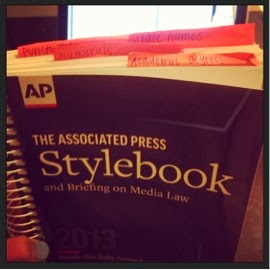
The Associated Press Stylebook is the bible of rules for writing news. My sophomore year of college, I took an entire classes dedicated to learning the ins and outs of this book. Back then, I had no idea how useful this training would be. Even though I have memorized many of the rules in the book, I still refer to it pretty much every time I write a news release to double-check a rule. Sometimes, I kick myself for having to look up a rule I should know one more time. But, I have come to realize that it is better to be safe than sorry. 

I have decided that instead of continually reading the AP Stylebook (a task similar to memorizing a dictionary), my familiarity with knowing what word or phrase has a rule and knowing how to quickly find a rule is sufficient. 

Knowing that a word or phrase has a rule is helpful, even though I may not know what the rule is. I find that this is my area of expertise. Because of my college days of memorizing rules, I am at least aware of what needs to be looked up, even if I do not know what the rule is off the top of my head. Because of this, I am regularly referring to my copy of the AP Stylebook. Nevertheless, navigating through the book can have its difficulties.

I am a book person. Even though the Stylebook is available online with a registered login, I prefer to use my hard copy. However, this can sometimes be difficult because the book is set up to not repeat rules often, even if it seems applicable. For example, if you are looking for the rule to see if a city can stand alone in a dateline, the first place you would naturally tend to look is under “C” for “cities.” However, you will only find the rule for “city” which is to “capitalize city if part of a proper name, an integral part of an official name, or a regularly used nickname: Kansas City, New York City, Windy City, City of Light, Fun City. Lowercase elsewhere…” This will not help answer your question. The correct answer can be found under “datelines.”

Here are a few examples of other rules that are frequently used and are not as easy to find as they should be.

  • Academic degrees. The rule for properly mentioning a degree to establish someone’s credentials or use in a biography. My first instinct is to always look under “D” for “degrees” instead of under “A.” The rule for “academic degree” gives a thorough explanation for all types of degrees and how you reference them. You can also look up specific degrees for a brief explanation of how to write them under the entry for “Bachelor of Arts, Bachelor or Science” and “Master of Arts, Master of Science, Master of Business Administration.” 
  • Dates. The rule for correctly writing a date. You would think that looking for “date” would give you the answer. However, this entry only gives you the rule to use Arabic figures, and does not mention how you should write the months of year. The complete rule for dates is located with the rule for “months” and referenced under “years.”
  • Numbers. The rule for how to reference numbers. However, there is no “numbers” entry in the book. There is a “numerals” entry that gives a brief explanation for how to use numbers for pretty much any situation including addresses, ages, vehicle names, dimensions, ratios, chapters, recipes, temperatures and more. Each of these topics has an in-depth explanation in their own entry.  

The Stylebook also has different sections with rules for specific topics. These sections are designed to make it easier to search for rules pertaining to these topics (as long as you know the section exists).

  • Punctuation. This section is dedicated to how to use punctuation marks. It lists all the rules for punctuation by symbol, rather than how the symbol is used. For instance, if you are looking for the rule for using a possessive noun or pronoun, you would look under “apostrophe” instead of under “possessive noun.”
  • Sports. This section explains rules for words and phrases pertaining to variety of sports such as scores, titles and names. It also contains definitions for commonly used sports jargon, as well as conferences, divisions and tournament information.
  • Food. This section shows common culinary conversions and writing guidelines for recipes. It also contains a complete list of food items and cooking techniques that explains the definition of the word and how to capitalize these items.
  • Fashion. This section contains the definition and writing rule for fashion and fabric terms, such as “A-line,” “epaulet,” “haute couture” and “pleat.” It also lists famous and commonly known fashion designers and gives a brief background on the designers.

These are just a few of the many tips and tricks to navigate through the AP Stylebook in order for you to efficiently and quickly finish your writing piece. I also suggest using Post-it notes to mark your frequently used rules. One day, I hope to know all the AP rules off hand, but I know that will come with time. For now, I will stick with my knowledge of what words need a rule and how to find them. If you know any other tips, please feel free to share in the comment section!


Thursday, January 16, 2014

No Punctuation Marks Were Harmed In Writing This Blog

Thomas Whitehead

During the holidays, I used some of my spare time to catch up on reading anything I could get my hands on – articles, periodicals, books, etc. Of everything I read, an article in the New Republic was probably the most interesting, telling and, possibly the most, alarming story I have read that could greatly impact interpersonal communication for years to come. 
The New Republic published an article discussing how, perhaps, the simplest punctuation mark, the period, has been transformed into a subtext that can indicate anger or disappointment when used in electronic conversations, especially texting. Yes, you read that correctly. A punctuation mark used to finish a declarative sentence (which in itself is merely a “declaration” of a statement) has now entered a place in culture where it, if used, can imply anger or frustration. 
The article indicated that the extra effort (and Twitter real estate) needed in adding a period to a sentence in written electronic communication was intended to imply aggression about the discussion, whereas a punctuation-free sentence (and I hear English teachers asking if this is even possible as I type this) is a casual, care-free zone.
Even further, the stats provided were telling. According to the article, a study by American University found that less than 50 percent of college students use periods at the end of both text messages and online chat conversations. 
Personally, I find this quite disappointing.  Without using punctuation to indicate the end of a thought or statement in written communication, especially when it segues into another statement, I feel that my absorption and understanding of the message becomes difficult to comprehend. It creates a distraction to the flow of how I read what is given to me. I could go on and on about how this is a further destruction of the English language, but instead, I am going to go a different direction. 
The reality is, if this is entering our culture, we have to at least be mindful of it, as well as the messages that periods or no periods can imply when we communicate. 
As communicators, especially those of us who still insist on using periods, we have to be aware, especially with younger audiences, that the period could mean to them that there is anger behind the statement, even if that is not our intent. 
We may not be able to always have people communicate in the ways we want them to, traditional or not.  However, if we are aware of different interpretations that exist in our society, we can strengthen our communication skills for the generations to come See what I mean